Warm up
Before starting the spinning program, in addition to doing some low-intensity exercise, there will be a targeted warm-up program in the formal class. The knees that are more prone to injury, the thighs that are prone to fatigue, and the waist should all be highly valued. The following actions are what you must do:

Leg stretch
Because the thigh is the center of the spinning exercise, be especially careful about getting strained.
Separate your legs as much as possible, bend your left knee, squat with your upper body, shift your weight to your left, fully stretch your right leg, pay attention to your toes forward, feel your inner thigh muscles tense and hold for 5 seconds, then switch legs and do it again.
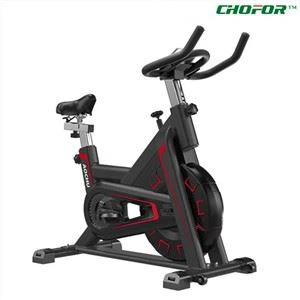
Leg stretches can also be done with the aid of a machine. Hold the handlebars with both hands, lift your left leg on the bicycle beam, stretch your right leg back, lean your upper body slightly forward, activate the ligaments and muscles of the leg, and then switch legs.
Side waist stretch
When simulating a bicycle passing through an emergency curve, the upper body should be swayed from side to side, and the center of gravity should be controlled with the strength of the waist, so that it can continue to be on the bicycle, and the waist is easily injured.
You can do a set of simple movements, keep your body straight, keep your lower body still, and do a 90-degree twist on your upper body; you can also do side-waist stretches, with your legs shoulder-width apart, and your arms raised to the top of your head to ensure that your body is in the same position. On a horizontal plane, the upper body is bent to the right. Do 5 reps on each side.
Shoulder press
Since the entire body leans forward slightly during the ride, there is a lot of stress on the shoulder joints and it is necessary to stretch the shoulder joints. Hold the handlebars with both hands, spread your legs apart, and bend your upper body forward, trying to get your body as close to the ground as possible.
Cycle
As long as you adjust your sitting posture, follow the coach to set off under the rendering of light and music. The simplest riding action does not need to be eloquent here, just walk at the rhythm. According to the shape of the handlebar, it is divided into four handle positions, and gradually exercise the oblique muscles, latissimus dorsi and arms.
Uphill
Rotate the weight control to increase the force on the legs, starting with the upper body leaning forward, and then needing the entire body to leave the seat to get the wheels spinning. The control of this weight is very important. Don't let the pedals move your legs, but take the initiative, fully grasp the speed of the metal wheels, focus on the thighs, and feel the muscles of the buttocks and back. It was also very tense and exhausting at this time. The legs are almost straight, reducing the burden on the knees, and the focus of the exercise is the muscles of the thighs and calves.
Downhill
To create a downhill feel, the weight control knob can be adjusted to the lightest, and there is basically no burden on the legs. Step on the pedals with ease, take your hands off the handlebars, straighten your upper body, and stretch your hands open, as if to embrace the breeze. Usually the music is softer at this time and the intensity of the movement is minimized.
Turn direction
The upper body must be exercised in conjunction with the legs to achieve the overall fat reduction effect. When simulating a sharp turn, hold the handlebars with both hands, and the upper body leans out to the left and right sides, basically offsetting the body's center of gravity, and using the waist strength to control the range of the upper body.